
Sofia
You work across performance, photography, writing and theatre. Does moving between forms give you different kinds of permission? What can you do in performance that you can't in photography or vice versa?
Moving between forms, or using them together, definitely opens up a door to more possibilities. It allows you to have a bit more agency in what you’re creating, while remaining playful. It lets you experiment with versatility, and keeps the work always dynamic and fluctuating.
There are loads of things you can't do while you photograph. You're definitely not on the stage; you're not performing. I think both are really similar, though. Because both in performance and in photography, there's an observation of the human being and their mind. In performance, which is more driven towards psychology or sociology, you study a character and its social context and try to portray them in the ‘most truthful’ way possible. In photography, you observe humans in their natural state or in their ‘posing’, artificial state. I think it’s really interesting. The other day I was doing a photoshoot for a theatre charity, and I had 20-minute slots. So, it was like in and out, in and out, “Hi! Bye!” And it's really funny because you see a glint, a little slice, of their personality in such a short amount of time. I have this thing when I photograph people. I kind of fall in love with the person I'm photographing. It’s a bit like meeting them through the lens. Especially when it comes to portraits. There’s a certain beauty and rawness in photographing someone up close. You see details. You guide them, and they respond. It’s a dialogue, just like in performance.
How do you then decide which medium a project needs, or does a project decide for you? Does it lead you in a way?
I think it goes both ways. There are some projects that I know straight away, “Okay, this time I want to do a theatre piece.” Sometimes I start with writing, mostly free writing. I struggle with starting by writing directly, though. I like devising with people. Often, I write a first draft, and I'm like, “This is shit.” I need to test it out in the space, make and play games and improvise characters with people in the room, so that I can bounce off ideas from the stimulus and the material. When it's just me and my brain in a room, it can become very overwhelming. I think collaboration is key in creation. And the choice of medium comes by itself throughout the process. I might start a photography project and realise it could become a story conveyed on stage or on paper.
Do you think there are any forms you find more difficult than others?
Yes, I mean… I juggle different forms. My main skill, or my main focus in training, has always been acting, with a little bit of singing on the side. I've never trained in photography; I taught myself. But with the arts, it’s so subjective anyway, it’s just about practising and refining. All the choreography and dancing aspects, though, I usually need to bring someone in for projects. I've done 10 years of dance growing up, but I'm not a professional dancer. So, when it comes to inventing choreo, I definitely need a professional. But I think, as I said before, the writing is probably the bit that scares the most, especially when it’s writing for theatre, with dialogue. Somehow, sharing a draft feels more vulnerable than devised work because it’s words on a page.
Now on to the practice: exploring the body, gaze and performance. Because you create that space with a research-led approach, I wanted to ask you: what is the female gaze to you?
To me, the female gaze is looking at the world in new, inclusive, radical ways that eradicate all sorts of categories or hierarchies. So, a lot of my work has been, you know, inspired by feminist theatre practices, and everyone's like “what does that mean, really?” Because it's so vague, and there are different waves of feminism. But the one I focused on in my research practice was the last wave: new materialistic feminism. As a whole, the female gaze is about giving agency, but mostly, I would say, it’s about subversion. In theatre, it's a lot about ‘taking and breaking’, because it's about taking the patriarchal system, breaking it down, disrupting it and recreating something new, for a brighter future or vision, and that is applied in the practice. So, for example, my show Babel Beast was a lot about taking material that already exists, mashing it up, and giving it to the audience in a new light that can sound, seem or look familiar, but it's fresh. You can resonate with it, but it also opens your mind. So yeah, female gaze is “fuck the patriarchy,” basically.
The series looks at "theatricality of scenographic material." What does that mean in practice?
It’s an academic concept discussed by Dr Rachel Hann. It took me a while to understand it when reading about it. In short, Scenographics is the interdisciplinary study and practice of creating and designing spatial environments, extending beyond theatre into everyday life. In New Materialism, there’s an importance placed on the object: objects become agents, placed at the same level as humans. That can, for example, veer towards an environmental discourse if we place greater importance on nature and take better care of our planet. It’s a large field of theories, and we could go on forever! But, what I focused on is what is called gender-assemblages, which stems from the idea that gender is a construct: it sees gender not as a fixed, binary identity, but as an evolving process formed by the interaction of bodies, materials, societal norms… This theory rejects essentialist definitions, towards a focus on the ‘becoming’ of gendered practices — a sort of performance.
In my practice, that meant creating character through theatrical costumes and props: I would display lots of objects, clothes, costumes and accessories on a table and let the subject who was going to be photographed choose from the pile to create a character of their choice. From there, the photoshoot would start, from the very choice of the items and the getting ready. Once ready, they would move in front of the backdrop, and I would ease them into giving life to their character through prompts and questions, focusing especially on the sensory experience they were having with the items chosen. How does a certain material you’re wearing impact the way you sit, stand, dance, talk, and behave? How does that affect your femininity or masculinity – and instead, is it something more fluid and versatile, and unique to you and to the character you’ve created? It was a dialogue. And it was beautiful to see what resulted from each exchange – each performance, in a way.
You started out using your grandmother's film camera. What difference does analogue versus digital make in exploring these bodies?
That's such an interesting question. I think that, already, just the technical and logistical aspects differ. I mean, with digital, you can take so many more shots. Film is expensive. You don't want to do a photoshoot on film because you don't even know what it's going to look like. When it comes to a proper one-hour session on digital, you see all the flaws, and you can change what you're doing. You see the work as you do it. So you can modify it and adapt it. On the other hand, I use film in everyday life, like spontaneously. I like taking shots when people are not looking at me. It captures moments of life that have that kind of spark and genuine aspect to them. So, let's say I use analogue every day and then digital for work, when people need polish or when there’s a specific goal.
Does embodied practice mean something specific to you, or is it just a way of saying you use your body in the work?
This is quite a tough one. Embodied can mean so many things. It can be using the body and movement in performance, but I think in acting itself, like in drama school training, it is about taking the work and making it yours. Characters that have been performed many times in the past should be seen in a new, fresh light. So, it's about taking in all the techniques and the teaching that they've given you, but then making it your own. It's also about training, as in practising in rehearsal, and then letting go of all the notes. And you just have it here (points to her head). You have it ingrained in your body and in your brain. Then I think there is embodied as in individual, personal stories: bringing yourself to the work in the sense that when you devise, you bring your own experience, you share it with the company, and they do the same.
So, what pulls you towards magical realism?
I think magical realism may be a way of not scaring audiences so much. A lot of people go to the theatre to escape reality or to be entertained. I personally believe theatre mirrors reality most of the time, or at least wants to say something about the world we live in, because that's why we do it in the first place. We do it to change, to create some changes, probably on a micro-level, you know, little by little. Or at least that's why I do it. Because you have a story to tell, a message to share, and hopefully, people will resonate with it. But I think magical realism is a way of telling a real story with a layer that adds that spice, that juice, that magic, that people will be enthralled by and attracted to. If you have a story about war, for example, and it's just like war, people might not want to see that because it's already what they see every day, even if just on the news. Not to say that’s how it should be done, of course! I love realistic theatre. But when it has a little hint of “there's something that is not ordinary,” or that leaves you questioning what’s going on, it just puts you on the edge of your seat for a second, and it makes you think. It activates a thought process, which I think is really important.
Exactly. And you do that in your own projects. You make people just not know what's coming next, and it kind of gives them that freedom.
And I love that. You never want the audience to expect what's coming next because then they're actually active in the space. They might be thinking, “What the hell is she going to do now?” And that's really funny and beautiful to see in their faces!
Long-term projects: you root them in collaboration, as you mentioned. You bounce off energies when you interact with them in the space, particularly with women and female-identifying subjects. And you've done your photography series, Women Performing, involving 50 different subjects, maybe even more. How did you find these people, and how did you decide that they're going to be the subjects?
I literally just put flyers all over uni, and did a call-out on socials. I was really surprised by the response. Within two hours, I already had so many people replying because, you know, it's a free photoshoot! People love getting photos. Especially nowadays, you know. The selfie century. I didn’t make a selection: it was about being as inclusive with the umbrella term ‘women’ as possible. I photographed ciswomen, transwomen, and non-binary subjects. Anyone who could and wanted to express femininity. Because the project was about deconstructing what femininity might even mean. And finding a plurality of femininities instead.
Kitchen Table’s aesthetic is homemade. Are you trying to challenge theatrical polish, or is this in search of intimacy?
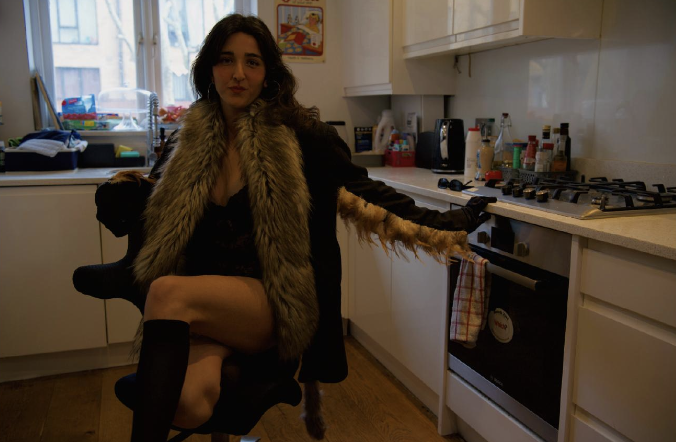
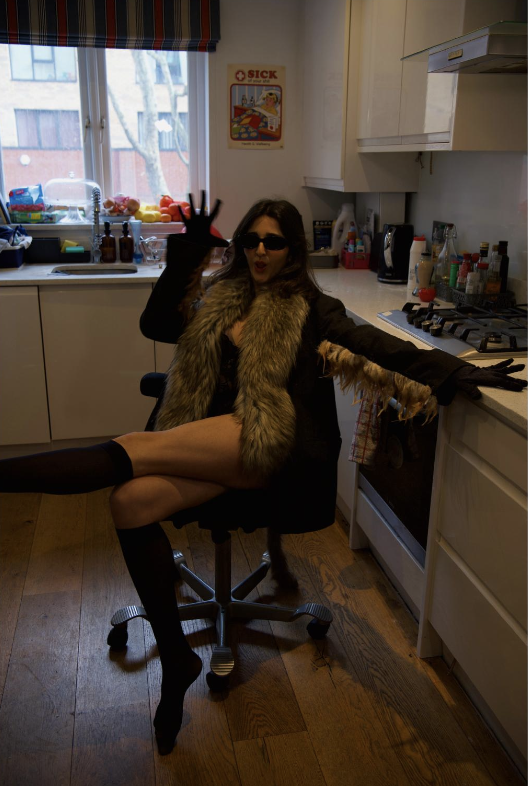
Kitchen Table’s name comes from three friends making work around a kitchen table: a space that is intimate, personal, domestic, where secrets are shared, and ideas are spilt. There's a sense of home, of personal, of connection around it. Of intimacy. It's homemade in the sense that we make everything ourselves. So, all the marketing, the material, the writing, the devising, the images, the editing – everything is original. We are an interdisciplinary theatre company striving to make work that is provocative, experimental, and socially impactful, and we stand for taking risks and making the familiar strange or weird. So it is about queer ways of making meaning, but that actually entails a lot of detail and polish. I wouldn’t say it goes against it, on the contrary: its very principle of mess, if it’s there, is on purpose. But yes, this homemade aesthetic is definitely about intimacy, going from the individual to the collective, and vice versa. Creating stories that span from the nostalgic and the chaotic, but are beautiful in their own way. Because that's what we all have in our homes.
Yeah. Raw and intimate.
Raw and intimate.
So you do use performance as both artwork and inquiry, not just presentation. Performance as inquiry. Does that mean that you don't always know what you're making when you start? You answered this a little before, when it comes to writing, but is it the same with acting or photography?
I think the inquiry is always there, even if you don't know it is. Acting and photography both entail an act of vision – seeing and being seen. I think that through art in general, you are researching and learning. It’s about being open and vulnerable and curious to the other, to the world, to something new that you haven't necessarily known before in your life. So, I think the inquiry inherently comes in the project, in the process. Now, whether you start with a question or with a concept, that's two different ways to do it. You know, most of the time, it was academic work that I was required to do, so you have to start with an inquiry. But it took me ages to find my questions. I would either start from practice or a lot of academic research – reading books, going to galleries, museums, watching movies, documentaries, trying to see what it is that interests me, so that it leads me to the thing that I want to pinpoint. Until I'm like, “yes, I love this. I want to know more about this. Let's do a project on this.” So, there'd always be a couple of months of research at first, and then the idea would spark out of nowhere, usually from writing or reading a random chapter in a book. And then I’d start the practice.
Women Performing was research-based. Did the photographs answer the question you started with or open new ones?
There isn’t a ‘solution’ to every problem or question, so it definitely elaborated and explored my initial question, but also opened new ones, yes. It worked with the theories I was writing about, and supported and underlined the arguments I made about fluidity and gender performativity. But it also made me realise that the male gaze was and is still internalised in most women. All the women I photographed have been and are still tied into the symbolic of the gaze, whether male or female, but my project allowed a dialogue and captured moments of interactivity between bodies and matter, giving them agency. And that is a practice I hope can be integrated more in the future, not only in theatrical processes but in the language of identity. One should view gender expression as multifaceted and continuously refining itself, and discover processes to connect back to who one was before being told to be someone else.
Do you see a difference between making art and doing research then, or do you think they're the same thing?
They're interwoven. I don't think they are the same thing. You know, there's art for the sake of art, or there's art that just comes from the heart; people just pour all of their soul into their work. I have friends who work without doing any academic research. Everyone has their own way of working at the end of the day. For me personally, research is key to the practice. They are interwoven. How can I write about a subject without having researched everything that has happened or has been said previously about it? That's also going to inspire you, or allow you to make it different. One is theory, one is practice, but I think they do come together; they support one another.
Babel Beast uses Medusa, the Sphinx, other monstresses. Why those figures?
The monstresses I chose for Babel Beast are all hybrid figures of Greek myths: they’re half-woman, half-animal, often combining more than 2 creatures at a time. The Sphynx has the features of a lion, an eagle and a woman; Medusa has snakes instead of hair; the Siren has the tail of a fish, the wings of a bird and the torso of a woman… It reflects the idea of cultural hybridity and being an in-between, a mixture of different elements, languages or identities, at the core of the show.
When reading about them, I found it funny that they are all portrayed as the evil monsters or obstacles in the hero’s path, but also pictured in very erotic ways, with huge breasts and beautiful, long hair. I found that very interesting, that balance of sexualization and monstrosity — it’s definitely something we played with in Babel Beast. There’s something about it in being ‘othered’, especially as a woman and a foreigner — you’re seen as sexy, ‘exotic’ or new, but still not a completely welcomed or belonging part of the place you find yourself in.
Exactly. You grew up with three languages yourself: French, Italian, and English, a bit of Spanish. Does switching languages on stage feel like switching identities or switching tools for you?
Both. I think in life in general, it is about switching personalities a little bit. I feel like I'm different when I speak English than when I speak French or Italian. On stage, I use it as a tool to bring in different kinds of storytelling and characters.
Why the interactive cabaret format?
The medium of cabaret works perfectly with the concept of hybridity at the core of the show, because it's so versatile and multidisciplinary. You can have some singing, some dancing, some comedy, some burlesque, striptease, drag, some monologue, some more experimental performance… You can literally do anything! So it mirrors that idea of multiplicity, of having different identities. It’s also a very intimate, DIY format of performance. It fits the themes of home and childhood nostalgia, as well as the risqué and sensual aesthetic.
The show is about language and culture. Making it interactive allows an exchange with the audience, which keeps them on their toes. It can either make them feel at ease and entertained, or, on the contrary, make them uncomfortable and scared to be approached. Either way, you are engaging in a dialogue, which, as an audience member, you might or might not understand — and that’s the experience of the multilingual individual.
The title is Babel Beast—Babel being about the confusion and breakdown of shared language. Tell me more about that.
The title is a play on words. It references the myth of the Tower of Babel in which God separated all humans by making them speak different languages so that they wouldn’t understand each other. By being unable to communicate, they wouldn’t reach their goal of building this huge tower to reach the sky, and hence God.
The word “Beast” here makes the pun: it’s the monsters in the show, of course, but also a saying, like the “beast of languages,” as in a master or champion in that skill.
This idea of confusion is paralleled with the “third-culture-kid” experience of growing up navigating more than one culture and language, and hence having knowledge about each one, but never enough to be fully a part of it. I’ll always be the “Frenchie” in Italy (even though I’m not French), and the Italian in England and so on…
It’s a confusion regarding identity: where does one belong? What can you call home when you feel shared and split in between spaces? But also a confusion inside the brain, mashing up words from different languages when speaking and translating — that is included in my show. In the diary scene, I read real extracts from my personal journal, which is written merging words from Italian, French and English, sometimes in the same sentence.
Burlesque is about revealing and concealing. Are you using that logic beyond the physical body — revealing and concealing language, culture, identity?
Yes, there is an aspect of that for sure. It’s the first time I'm doing burlesque, especially in a show, and I surprisingly found it really enjoyable and not as intimidating or exposing as I would have expected! That’s because I’m playing a character — the Siren is stripping, not Sofia. It’s acting. And I think that plays into the idea of revealing and concealing identity, which is further explored and broken down: as the show goes on, you see flashes of the ‘real’ Sofia come through at moments in between the multi-roleing of characters. It is definitely something we have planned to develop for the next runs of the show. We are curious to see how much we can push the extreme characters versus moments of authenticity and letting go of all the ‘masks.’
Aside from that, burlesque itself is defined as risqué. There’s risk involved in it, both for the performer who is exposing themselves (literally), and for the audience who is put in the potential position of being touched, seduced, or just allowed to look at a body. Overall, the show as a whole takes risks. The diary section is a risk; it’s very vulnerable and personal to read one’s journal out loud to an audience. The pomegranate-eating is a risk; some people might not understand or be into experimental performance. Clowning is a risk because it's truly scary to do! (laughs) Audience interaction is a risk, because if there’s no audience, there’s no show… But that's why we do it. That's why we do theatre at the end of the day, for the risk. Because at least it makes it unique and radical, in a certain way, and hopefully stimulates people’s minds.
Cracks was a magical-realist play, Babel Beast is a mythic cabaret. Do you need non-realist frameworks to talk about identity, or is that just what interests you formally?
I don’t know if it’s a need. I find myth extremely current, adaptable and relatable to any social, political, or historical framework. Myths can be universal but also stripped down to very specific individual stories, which is why we’ve kept adapting Greek plays over and over for centuries. I’ve always been really interested in mythology since I was a child, so it was definitely bound to happen in one of my projects.
I think talking about identity when it comes to autobiography can quickly become self-indulgent, and that’s a bit of a risk with solo shows in general. I wanted to tackle the theme of identity in a playful and relatable way, without making my story necessarily a ‘victim’ narrative, because it’s not. Having a non-realist framework, I think, supports and pushes you to establish playfulness about your own story without taking yourself too seriously, but hopefully still activates some sort of thought process, both in the performer and in the audience.
Do you have any upcoming projects?
I’m doing a dance-theatre residency with the company Le Gramigne in Italy. The show, La Danza della Sesia, will be on the 28th of June at the Auditorium of Gambolò!
Find all links to all of Sofia’s events here or check out @kitchentabletheatre Instagram page.
Artist @sofnatoli