
The Body Remembers What it Repeats: On Pina Bausch
Anna Maria SommaThere is a scene in Pina Bausch's Café Müller, premiered in 1978, where a couple is positioned by a third figure, a man who arranges their bodies with the methodical patience of someone setting a table. He fixes them into an embrace. He positions the woman in the man's arms. The phrase ends with her falling to the floor. She rises. He arranges them again. The loop begins. Faster this time. And faster. Until the third man leaves, and the couple continues, without prompting, repeating the sequence with terrifying automatism.
What haunts this image is not the fall, but the getting up. The return. The willingness — or compulsion — to begin again.
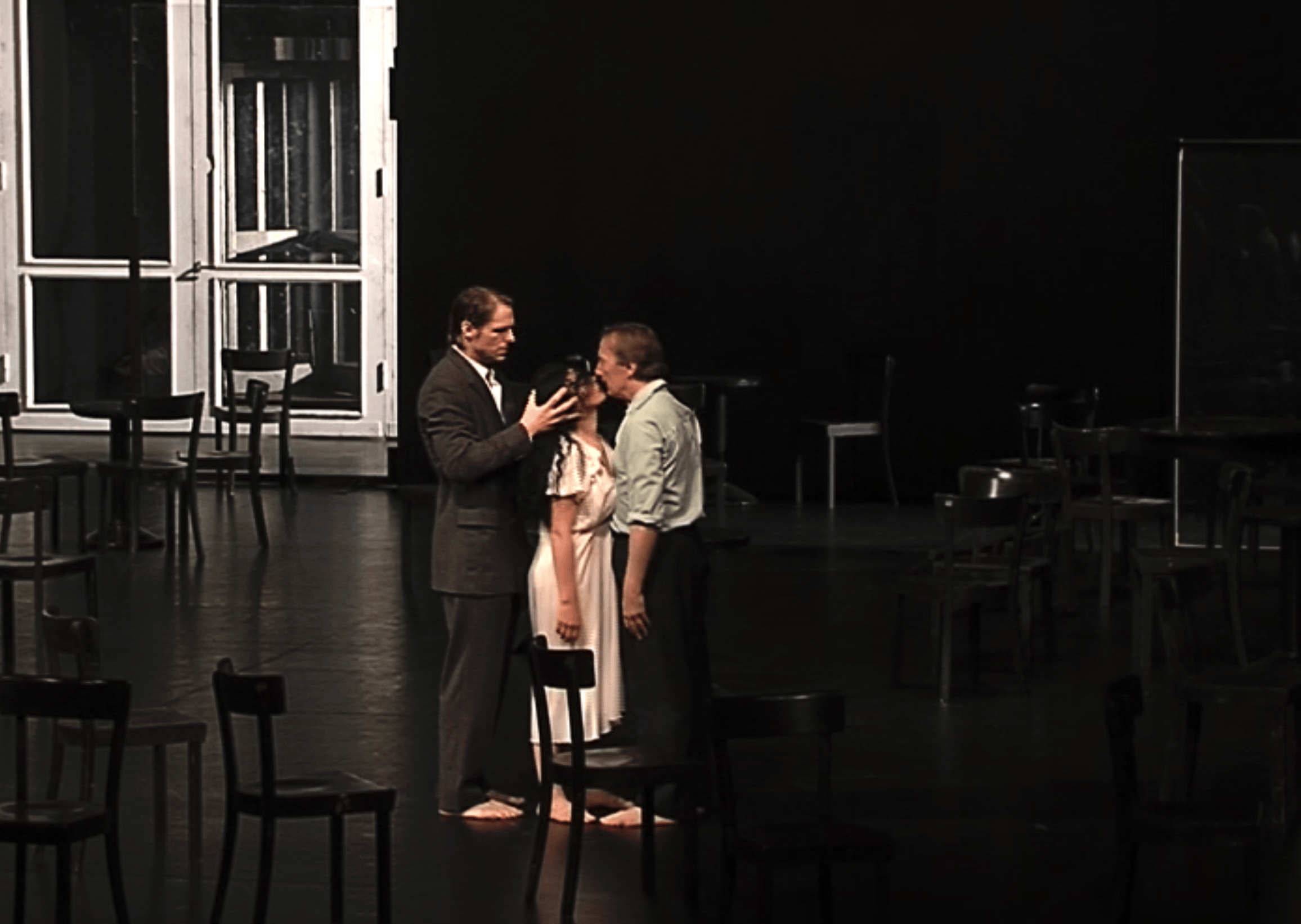
Aida Vainieri, Dominique Mercy and Michael Strecker in “Café Müller” by Pina Bausch in Opernhaus Wuppertal, season 1977/78Judith Butler's argument, made in Gender Trouble (1990) and in her earlier essay Performative Acts and Gender Construction (1988), is now so embedded in cultural discourse that it can feel like a given: gender is not something we are but something we do. What Butler describes is, in essence, choreography. And Bausch, though she arrived at this understanding through entirely different means — through sweat and studio floor and the kind of questions she famously asked her dancers (What do you do when you're afraid? What moves you?), stages it with uncanny precision.
The loop in Café Müller does not illustrate Butler's thesis so much as enact it. Repetition here is not stylistic; it is structural. Each iteration of the embrace-and-fall is slightly off, slightly more desperate than the last. The gestures don't accumulate into fluency; they accumulate into something closer to compulsion. The man fails, again and again, to hold the woman. She falls, again and again, and rises to try once more. One watches and begins to feel the weight of the question underneath: who taught them to do this? And who taught them it was the only way?
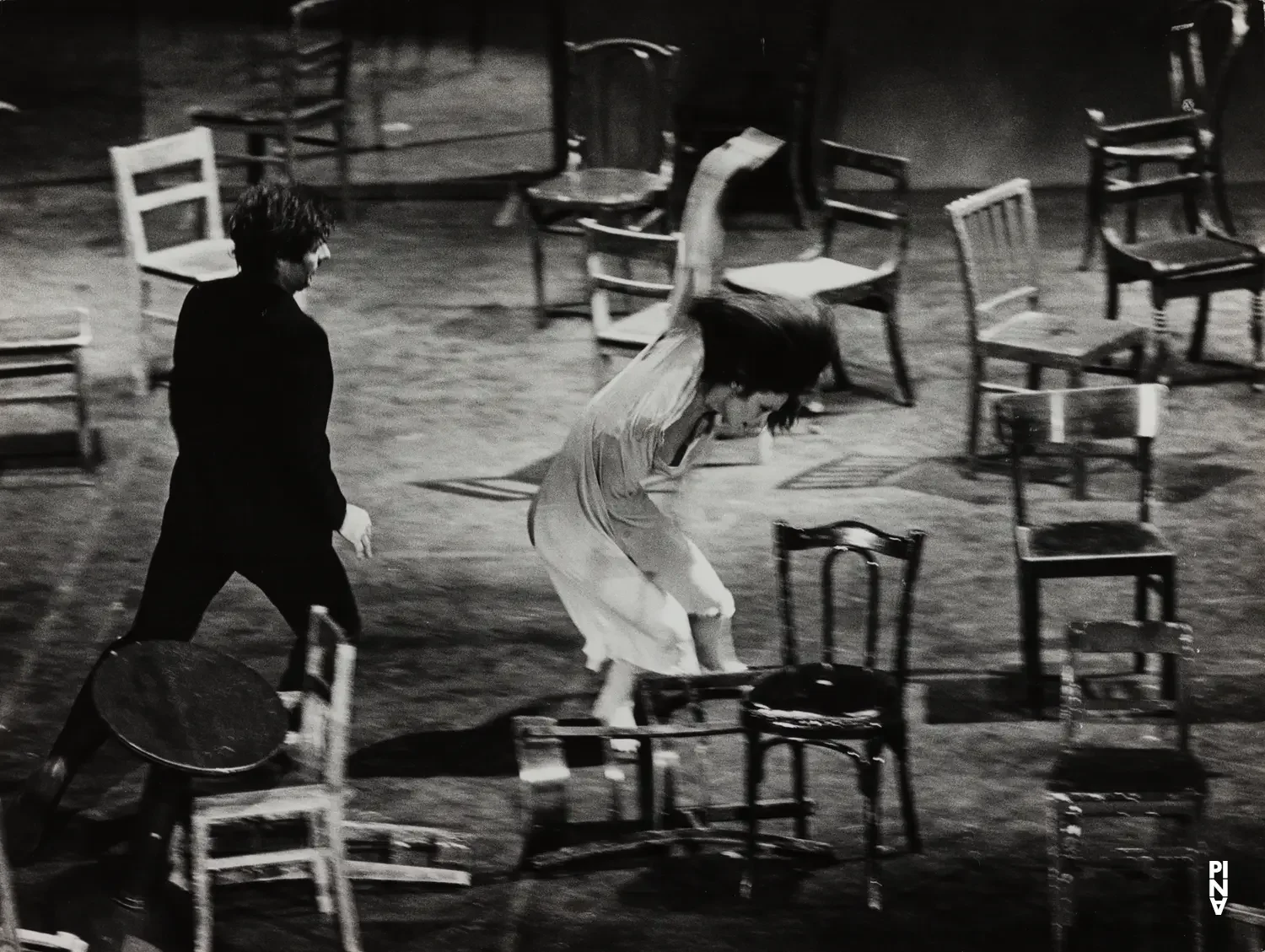
Malou Airaudo and Rolf Borzik in “Café Müller” by Pina Bausch, season 1977/78, photo by Ulli WeissGender, like a choreographic score, is constituted through a stylised repetition of acts and gestures accumulated over time, rehearsed and re-rehearsed, until they sediment into something that looks, from a distance, like nature, the same way a script does for the theatre actor. The body becomes a historical sign: a contended territory onto which social norms are slowly, persistently inscribed.
To understand the body as a scored object — something that learns its part and performs it — is to understand the social choreographies that shape the never-fulfilled but perpetual quest for contact that moves Bausch’s dancers through the stage. Choreographies that reveal themselves also outside of the black box; in postures, in reflexes, in the distance we keep from strangers, in the way we learn to offer or withhold a hand. Bausch's rehearsal process worked in precisely this register. She built her pieces through repeated questioning, through the mining of personal experience and gesture, returning to the same materials until something crystallised — or fractured.
What Tanztheater introduces, then, is a body subjected to cultural structures, and whose movements unveil the expressive genesis of private emotions and the cultural codes that inform them. In the training vocabulary of classical ballet, effort is concealed — the whole aim is levity, the body that floats. Bausch inverts this: fatigue is foregrounded, exhaustion is present, the body is shown as something that labours under its own history. The dancers in Café Müller move through the stage with their eyes closed, arms outstretched, navigating — or failing to navigate — a space dense with chairs and tables. The obstacles are literal and also not. They figure the ways in which identity is shaped by the furniture of the world: the arrangements of power and convention that one bumps against, that redirect and impede.
In Kontakthof, which premiered the same year, the question becomes more expansive: what does it look like when a whole social world rehearses itself?
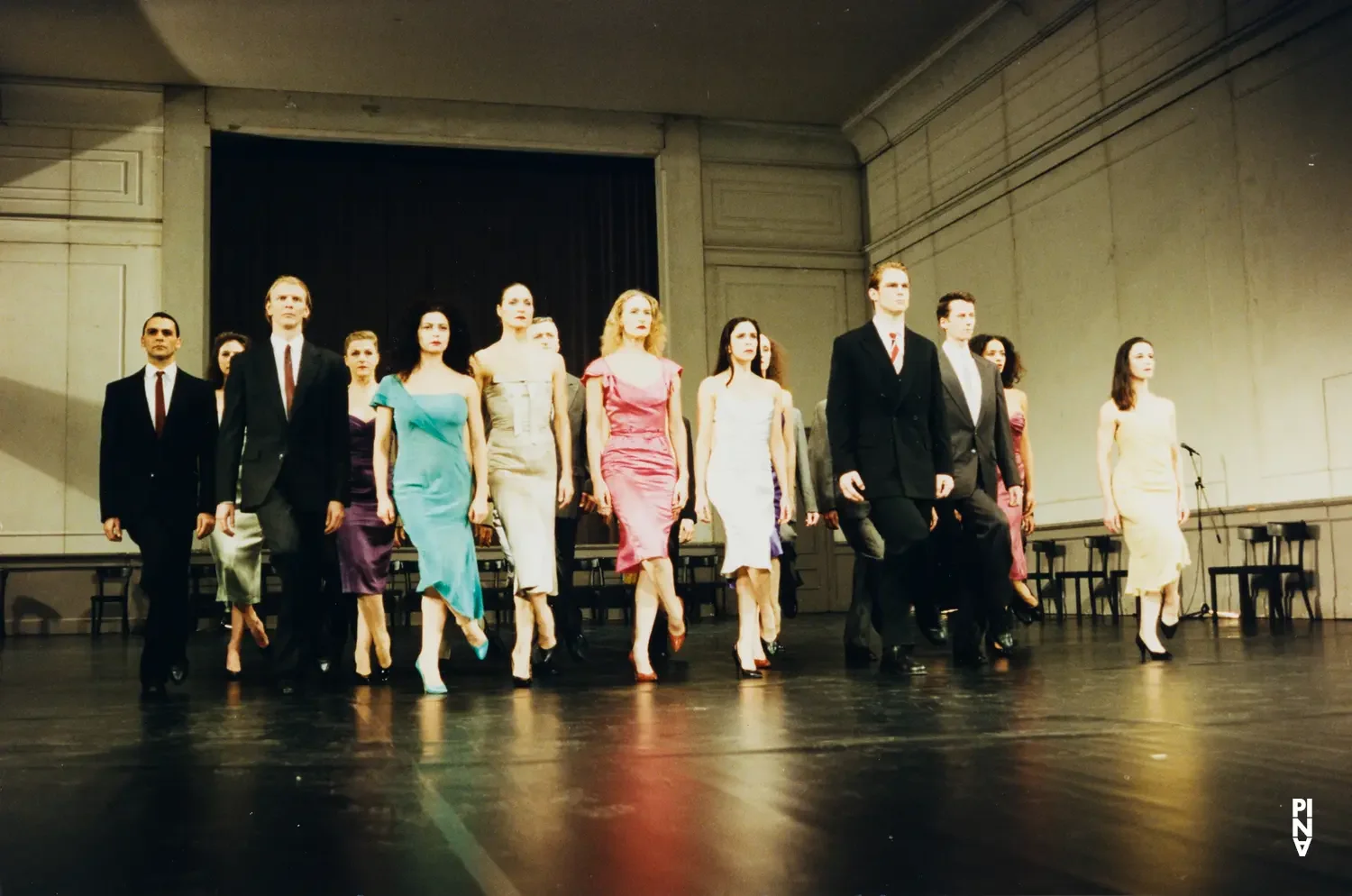
“Kontakthof” by Pina Bausch, season 1978/79, photo by Ulli WeissThe piece opens with a parade. Performers walk to the front of the stage one by one, turning to present their front, their side, their back — like contestants in a pageant, or defendants in a line-up. They show their foreheads, their smiles, their hands. The presentation continues throughout the piece: men and women enacting encounter after encounter — tenderness that turns to manipulation, flirtation that tips into coercion, a shy mutual undressing conducted across the full width of the stage.
Kontakthof — which translates, roughly, as meeting place, where anything from dating to prostitution can happen — is interested in the scale of the collective. If Café Müller stages the private compulsions of the individual and the couple, Kontakthof stages the social. And what it reveals is not one person performing gender, but an entire room of people performing it at once, all slightly out of sync, all slightly failing to meet.
At one point, a woman is left alone onstage. Men enter and begin to touch her — at first gently, then not. She does not move. As Raimund Hoghe, who assisted Bausch during rehearsals, described it: tenderness becomes violence as touch turns to assault. The scene is almost unbearable to watch. It is also deeply precise: it imagines what it looks like when the social choreography of femininity arrives at its endpoint.
But here is what Bausch insists: repetition is not futile.
In a 1985 interview with The New York Times, she addressed the question of her obsessive returns directly. 'Repetition is not repetition,' she said. 'The same action makes you feel something completely different by the end.'
Each loop of the Café Müller embrace is identical in its structure and different in its meaning. By the time the third man has left the stage, the gesture has become detached from its originating instruction; what was learned behaviour has been exposed as such, and in that exposure — that distancing — lies the possibility of something other. The audience is not permitted the comfort of pure empathy. They watch, they flinch, they think.
These broken mechanisms of repetition are what make transformation possible: the repeated score as a tool that makes artifice visible, that creates space between the performer and the performed. What choreography can do — what dance theatre uniquely does — is render the score audible. To see gender as a score is already to begin to imagine it otherwise.
Bausch's theatre holds this truth in the body. Not as theory but as sensation: the weight of the falling woman, the mechanical speed of the repeated embrace, the terrible beauty of the couple performing their assigned roles after the instructor has already left the stage.
We rehearse ourselves constantly; we loop through our own presentations — the way we modulate tone in different rooms, adjust posture, learn, and relearn the gestures that mark us as legible within the social worlds we move through. The self is not stable. It is tenuously constituted in time.
Bausch’s power lies in her ability to strum the deepest chords of recognition; to make you feel like each gesture is somehow familiar to you, as if you have rehearsed it yourself without anyone having to ask.
I’m thinking about this on a Sunday afternoon, sitting at a café's window table, overlooking a dance studio. And, as I struggle to find an appropriate conclusion, I see a boy walking out of the dance studio to cross the street. He looks left and right before crossing, and as he sets his first step on the road, he begins shyly rehearsing the steps he must have learnt in class. In his furrowed brow I can read the ‘5, 6,7,8’ that precede the start of the sequence, and the slight reluctance between each step as all the movements are pieced together in a coherent score. In his next class he’ll keep rehearsing the score until he forgets that the phrase once existed as a broken ensemble of separate utterances. He’ll dance it as if that was the natural language of his body, one movement leading into the next, feeding it, prophesying it. The body in motion is a body that dances. The body in love, the body in protest, the body at work. The sad body, the grieving body, the body that rushes, the body that serves, the body that waits, the body that stutters. The impatient body, the fighting body, the body that surrenders… The boy reaches the other side of the street and the sequence dissolves back into a walk. He doesn’t notice, but I do. The choreography continues, and somewhere in the noticing, something begins to shift.
Anna Maria Somma