
Metabolic Weathers
Alix emeryIt’s the golden age of industrial accidents. Anyone can wake up in our leaking infrastructure and enjoy a few minutes bathed in a multi-million-pound toxic escape. From slow chemical leaks in gas mains to noxious exposure in the winds of global warfare, these new toxicities are entering our bloodstreams and altering our hormonal systems. As the boundary between industrial ooze and daily life dissolves, an uneasy question emerges: who is now narrating this story?
Living bathed in artificial light, screens and streetlamps suppress melatonin long after sunset, thinning our sense of the boundary between day and night. Economic precarity and late-night crisis notifications sustain low, persistent elevations of cortisol, while dopamine optimisation loops kick in as we binge-watch season after season. Gently we fall into a deepening chaos of light sleep, heightened anxiety and emotional volatility, and emerge from our duvet restless, alert, stimulation-seeking; co-authored, not totally by personal deficiencies, but by late capitalism’s architecture around us.
Unfortunately, there is no such thing as a reliable identity. At best, you are a small percentage of the person you say you are, and that person is suspect. Identity is uncertain, unstable, unfinished—constantly remade while life moves through us: emotional hurricanes, the slow grind of austerity, bedrotting to the rhythm of roadside fumes. Plastic is now found in human blood, lungs, placentas and breast milk, reforming our biologies and behaviours. And although identity might be a construct, hormones are really real.
My doomscrolling has been saturated lately with “synergised lipid matrices” promising natural botox glow-ups to heal me back to an unrecognisable myth of brilliant former health. The advert spins a mythic tie between minimalist wellness aesthetics and reclaiming control over my body. Mustard yellow pill bottles tell me about the new clean girl secret: You're Looking Well’s ‘Night Pill’ and the new luxury of a “rested appearance.” The myth of the “natural” body is alive and well, serenading us online with its belief in a detox to some antiseptic, virgin self, untouched by politics, technology, and environmental collapse. But creative and scientific thinking points to a more porous interplay: that nervous systems are responding to atmospheric chemistry, and are ruled by pollution and extractive economies equally, if not more than, by our individual choices.
As hormones adapt to our technological present, responding to microplastics, stress economies and digital pulses of reward, they materialise the reality of Donna Haraway’s Cyborg Manifesto. In her writing, the cyborg is sentient and a creeping horror sets in as we realise the cyborg she describes is not speculative at all, but us. The fiction of an incorruptible identity becomes untenable. Part organism, part machine, Donna Haraway describes how the reified boundaries between body and technology, nature and culture, never existed, revealing identity as something continually assembled within networks of biology, media and power.
But who really wants to be bound by the binaries of purity and contamination? In a time of seeing a stronger need for Donna Haraway’s cross-species “sympoiesis” (making-with) due to the ecological collapse, the metaphor of contamination and pollution is classic in its reductiveness. We can’t detox ourselves back to the fantasy of a natural state, but we can renegotiate our bodies, re-patterning their entanglement. Some artists caught the fallout early. Sophia Al-Maria recognised the ecological crisis as a bodily reality in Sad Sack, collapsing late capitalist infrastructure and flesh by way of a Britney Spears’ love letter. Her writing wriggles in domestic military-industrial warzones while a melancholic, oil-soaked atmosphere seeps through the characters, churning petrochemicals into new endocrine landscapes where exhaustion and desire are chemically conditioned side products. Sad Sack captures a wider cultural moment where hormones have moved from the clinic to culture, evidenced by the upsurge of workshops, research programmes, and exhibitions treating the endocrine system as a medium. Meanwhile, research into endocrine disruption has only grown, showing that synthetic chemicals used in common plastics, such as BPA and phthalates, mimic estrogen and testosterone, toying with our emotions and desires. The change is palpable. Hormones themselves have become a strange cultural hinge: a pinch point where eco-artists and incel forums pushing muscle-enhancing hormones meet.

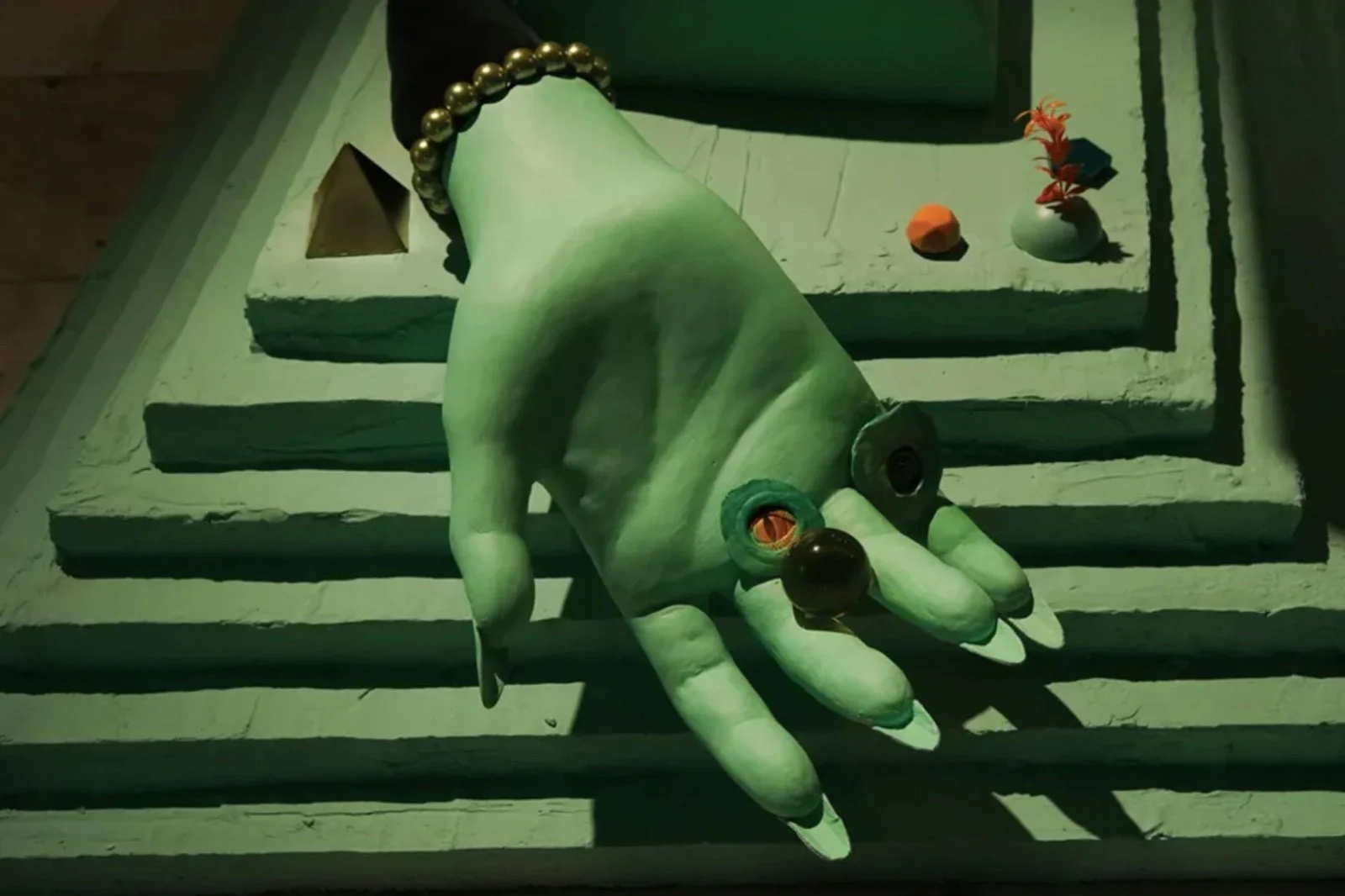

1 Sophia Al-Maria. The artist resting from endometriosis in We Ride and Die with You published in Sad Sack. Photo: artist’s father.2 Sophia Al-Maria. Beast Type Song (2019) (still). Courtesy the artist.3 Tai Shani. DC: Psy Chic Anem One (detail), 2018, polystyrene, jesmonite, paint, steel, fabric, aluminum, polyurethane foam, glass, wood, plaster, and resin; in the Athens Biennial. Photo: Nysos Vasilopoulos.Ecologically conditioned, politically influenced, chemically modulated: how can we resist? As artists know, it’s possible to live in the entrails of late capitalism without losing your humanity. The environment doesn’t just surround the body—it enters it, modulates it and co-authors it, a dynamic echoed in Tai Shani’s baroque mythologies which reimagine endocrine systems as portals to new possibilities. In Our Fatal Magic, Shani creates an alchemical landscape populated by fluid, semi-mythic figures such as the hormonally charged ‘Neanderthal Hermaphrodrite,’ and the synthetically altruistic ‘Psy Chic Anem One’ whose births and séances summon bodies porous to toxins and psychic intensities, repelling sadistic genealogies of mothers and fathers. From grains contaminated with ergot in medieval Europe, to today’s microplastics, Tai Shani’s confessions are chemically sensitive to their surroundings. Whether dusty ancient terrains or the occult eighteenth floor of the Luxor building, they bleed potent sensations and desire into the architectures they inhabit. Physiology, magic and environment fold into one another, suggesting endocrine systems as leaky interfaces through which toxicity and pleasure digest disruption into transformation. What we think of as identity may be an environmental imprint in flux and a terrain for experimentation.
Taey Iohe and Rishita Nandagiri extended this experimentation to real people and action in their workshop series Insurgent Hormones, where participants asked: ‘What has leaked into our homes? What hormone mutants and queer-kin life could we be?’ The idea of aborting something toxic became both danger and opportunity: reimagining pollutants as transformative matter for careful deal-breakings. Endocrine disruption was reframed not only as a site of vulnerability, but as a space for play, bringing strength to the face of damage and risk. By creating bodies capable of negotiation, these practices embrace fluctuation, contradiction and porosity as moments of survival and transformation, repositioning identity not as wounded, but as an ecological interface for new histories.
We are changing in gestures and in glands. Identity is being revised, not only through conscious acts of curation, but through invisible chemical edits unfolding beneath the skin. What feels like fragmentation where identity once seemed stable and whole may not be fracture at all, but rather the formation of new circulations through hormonal systems that recalibrate to make us more adaptive and responsive to a contemporary climate. Co-evolving with a cluster of pollutants is terrifying, but it's also a ridiculous place of unique possibility. Loosening the grip of genetic forefathers allows us to rethink the limits of our capacities. To live within this reality is not to forfeit our imprint, but to understand it differently—as something metabolic and in motion.
alix emery