
The Soft Surveillance of
Supermarket Baskets
SELIN KIRWe’ve become fluent in reading fragments.
Not formally; no one teaches it, but through repetition, exposure, and the slow conditioning of contemporary life. A water bottle, a skincare shelf, a Notes app screenshot: each arrives preloaded with meaning, primed for interpretation. The supermarket basket sits quietly among these objects, but it may be the most condensed instance of the phenomenon: a life, briefly assembled, suspended in legibility.
It doesn’t take much.
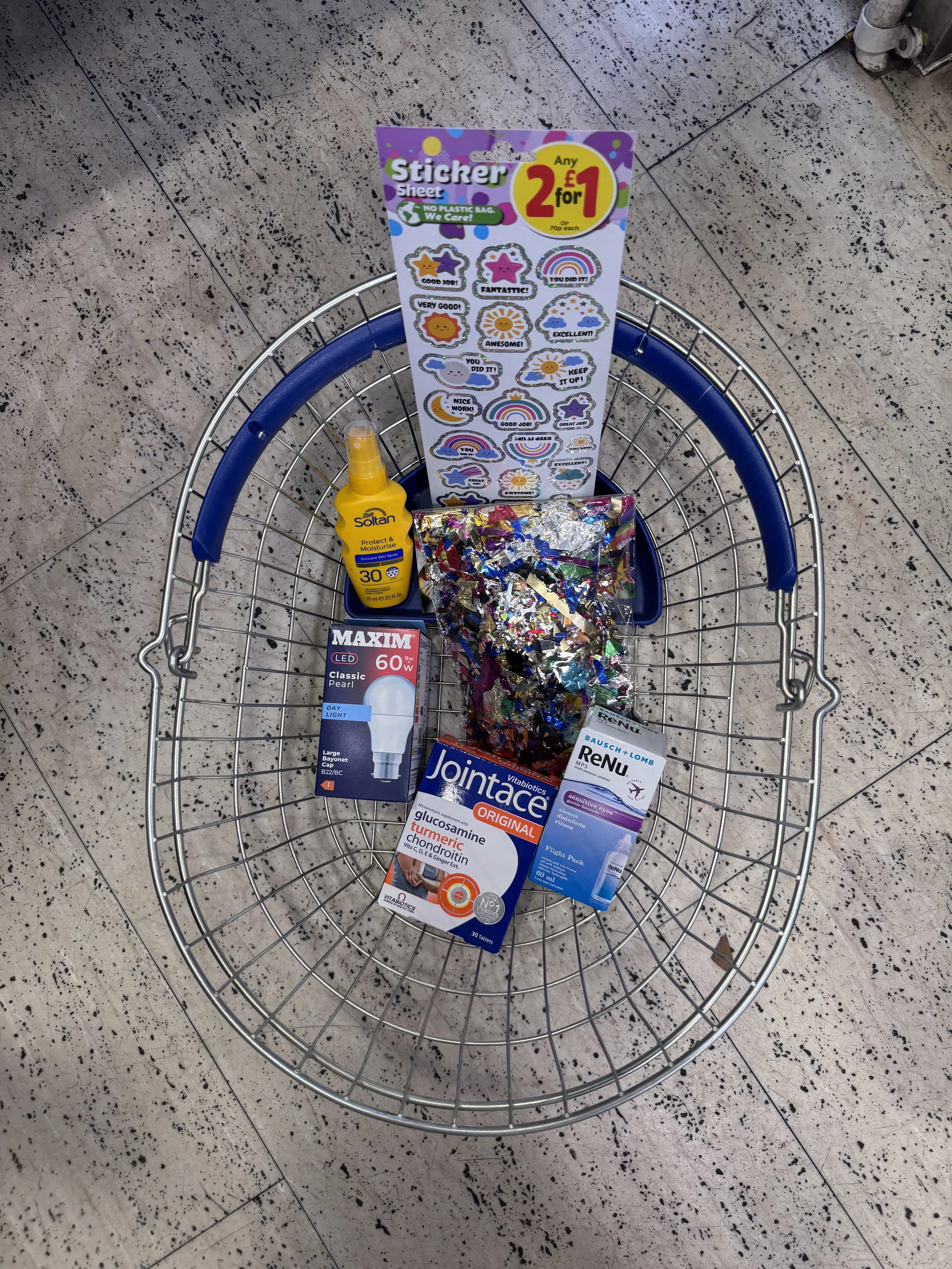
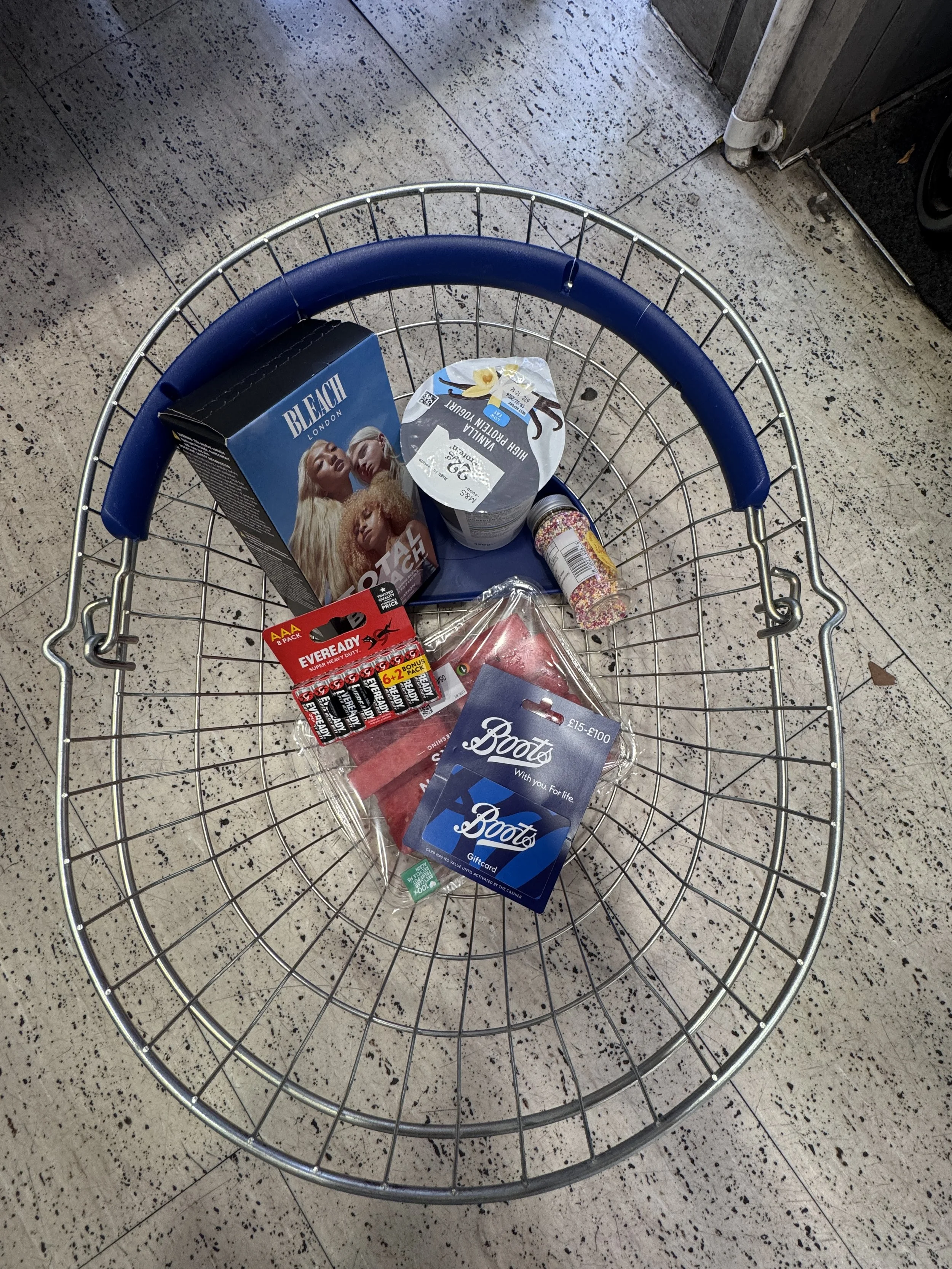
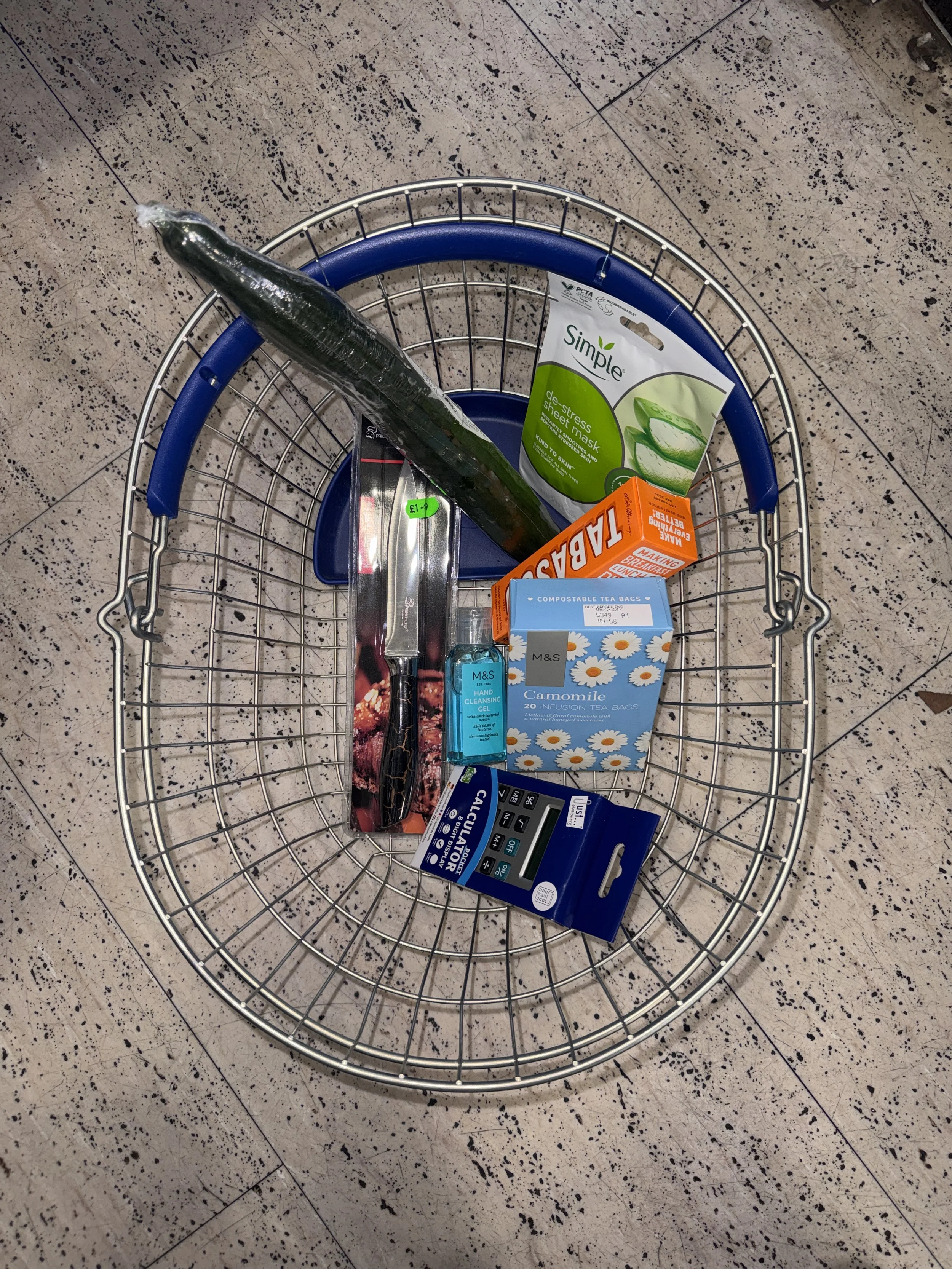
A cucumber, chamomile tea, a sheet mask. Hair bleach beside protein yoghurt, watermelon, sprinkles, batteries, a Boots gift card. Joint supplements next to sunscreen, confetti, stickers, lens solution, a lightbulb. Individually, the items are banal. In proximity, they begin to cohere. Within seconds, a figure emerges: provisional, speculative, but convincing.
This is often framed as casual curiosity, a low-stakes form of people-watching. But the speed and confidence of these readings point to something more systematised. Interpretation draws on a shared repertoire of scripts, stereotypes, and scene-knowledge already circulating in culture. The basket does not require explanation because it is already encoded.
Certain objects arrive heavier than others.
Hair bleach, for instance, rarely functions as a neutral purchase. It carries with it an entire aesthetic ecology: reinvention, self-editing, a calibrated break from a previous version of the self. It belongs to a visual and cultural field shaped by nightlife, DIY transformation, and the labour of appearing unlaboured. Placed beside protein yoghurt and sprinkles, the tension sharpens. Discipline and indulgence sit in uneasy adjacency. Batteries and a pharmacy gift card introduce something administrative, almost deflationary. Life continues, even as it is being revised.
Elsewhere, the signals destabilise.
Chamomile tea, cucumber slices, a sheet mask. These align initially with the familiar grammar of contemporary self-care. The presence of a calculator disrupts the atmosphere almost immediately. The knife and Tabasco complicate it further. What might have read as restoration begins to feel procedural, even faintly clinical. Care shifts toward regulation.
This slippage is instructive.
Objects no longer function simply as objects. They operate as compressed semiotic units, shaped by branding, wellness discourse, algorithmic aesthetics, and the broader imperative to render life legible. A product rarely arrives empty of signifiers; it arrives already narrated. Calm, discipline, indulgence, repair. These meanings activate the moment an object enters a visible configuration.
The supermarket basket accelerates this logic. It forces these signals into proximity before they can stabilise. Contradictions surface. So do the micro-negotiations that structure everyday life.
Some baskets refuse coherence altogether.
Joint supplements, sunscreen, confetti, stickers, lens solution, a lightbulb. No clear narrative consolidates. Instead, something closer to logistics appears. The body requires maintenance. The house requires fixing. Something social is pending. The arrangement resists aesthetic alignment, and in doing so, feels oddly precise. Less like identity, more like scheduling.
These are often the most revealing.
Contemporary identity is typically presented as internally consistent. Tastes, habits, aesthetics aligning into something like a curated moodboard. But daily life accumulates otherwise. Needs overlap. Desires contradict. Practicalities interrupt performance.
The basket makes this visible with almost no effort.
For a brief interval, multiple versions of the self are held in suspension: the disciplined one, the indulgent one, the social one, the depleted one, the one attempting change, the one maintaining what already exists. They do not resolve themselves. They coexist together.
What matters is not the accuracy of these readings, they are, at best, partial projections, but the consistency of the interpretive framework. The same tonal cues recur. Certain combinations read as aspirational, others as suspect, others as quietly excessive or faintly unravelled. A shared cultural lexicon is being mobilised in real time. The basket becomes a surface onto which these assumptions are mapped.
In that sense, the act of reading it is not entirely benign.
It mirrors, in a softer, more intuitive register, the logic of systems that already parse consumption into data. Recommendation engines, behavioural tracking, market segmentation: all operate on the premise that patterns of purchase can stabilise identity. The distinction is tonal rather than structural. Where systems produce correlation, the human eye produces narrative. Where algorithms generate probability, the passer-by produces character.
Both proceed from the same assumption: that enough objects, arranged together, will render a person legible.
The supermarket basket offers this promise briefly. It suggests that identity can be assembled from fragments, grasped at a glance, made coherent without context. And for a moment, under fluorescent light, it almost holds.
Until the items are bagged.
And whatever coherence was briefly projected dissolves back into something less stable, less visible, and far more difficult to read.
SELIN KIR