
What Is Left of Me When My Basket Is Empty?
LEELOU REBOHEat me. Drink me. Please consume me entirely.
“I downloaded Hinge again,” one of my friends recently told me. As a seasoned dating app user myself, I couldn’t refrain from sighing. I knew I could already predict the entire plot that was about to unfold. Ironically enough, and even though my days on the online market are behind me (“for real, this time,” I told that same friend the day I decided to delete it from my phone), I used to love Hinge. I loved meeting all those people I would’ve never otherwise encountered. Unashamedly, I enjoyed the temporary, gratifying rush of validation each time I’d look at the bottom of my screen and see the “+50 likes” icon. Possibly even more ironic is the fact that, in 23 years, my two most serious relationships since I decided to put myself “out there” spawned from the relentless, mechanical movement of my thumb—going left more often than it did right. I even developed my own set of rules I was adamant my friends should apply to themselves whenever they’d bring up their dissatisfaction with their online interactions. Rule #1: be patient and train the algorithm before giving up (it might take a few days). Rule #2 (and the most important one): be the one doing the liking, not the other way around. Sent likes often result in matches, and come with very rare disappointment, as you’re the one picking and choosing.
Yet, the theatrics of the app remain the same: there’s a compelling match or two, and plans to meet. One carefully elaborates the persona to put forth for the occasion. The evening of, a brilliantly rehearsed performance of the self, sometimes leading to a kiss, a hookup, a morning after. Attachment might ensue, a few days or a couple of weeks of blissful fun, ultimately resulting in… well, nothing. Again.
We’ve become bulimic with our relationships. We gluttonously consume to the point of feeling sick because there is always more. What if I’m missing out? The supply of humans to meet seems endless, and it can be scanned rapidly with a swipe across our screens. Sociologist Eva Illouz, whose work reflects on the intersection of consumer capitalism and modern romance, defines the roles we play within the online dating market: the “self” as a commodity, and the “other” as a consumer choice. “The visual regime has been amplified and intensified by the emergence of online dating sites and social media,” she writes in her 2019 book The End of Love: A Sociology of Negative Relations. “That places individuals in a position where they must present themselves in an idealised and attractive manner across various visual platforms.” Why care about meticulous selection when we can fill our baskets with so many different “people products”, right?
Let’s not delude ourselves, though; it’s not only others we standardise into commodities. Our own profiles are filled with typically desirable and readily consumable attributes.
I remember sitting around with my flatmates when I was updating my Hinge account—it’d become a joint activity, and we’d swap phones, taking turns scrolling and selecting the better suitors. “You don’t want to only be seen as a baddie on here,” my male friend advised. “You want the playful side of your personality to shine through, go beyond looks. At least, that’s what makes me match with girls.” My girlfriends were more specific: they’d spend time going through my camera roll for me, selecting the best pictures I had of myself. After careful consideration from my couch-bound jury, there it finally was: my very own online advertisement, promoting nothing less than the most optimised version of myself. Hello, World! Here I finally am.
Infinite choice is an enticing prospect. Yet, after a few dates, my friends and I quickly learned that this led not to more love, but to the constant evaluation of whether one could find something better: better interactions, better looks, better jobs, better sex… Better, better, better! “The three characteristics of visual evaluation – the speed, one-sidedness, and binary character of visual representation are becoming formalised and institutionalised by hookup apps like Tinder, turning persons into techno-emodities – consumable promises for an emotional (and sexual) experience.” Illouz writes. If love was once perceived as an emotion so transcending that it could become its own kind of religious experience, it now seems we’ve become desensitised to emotional connections.
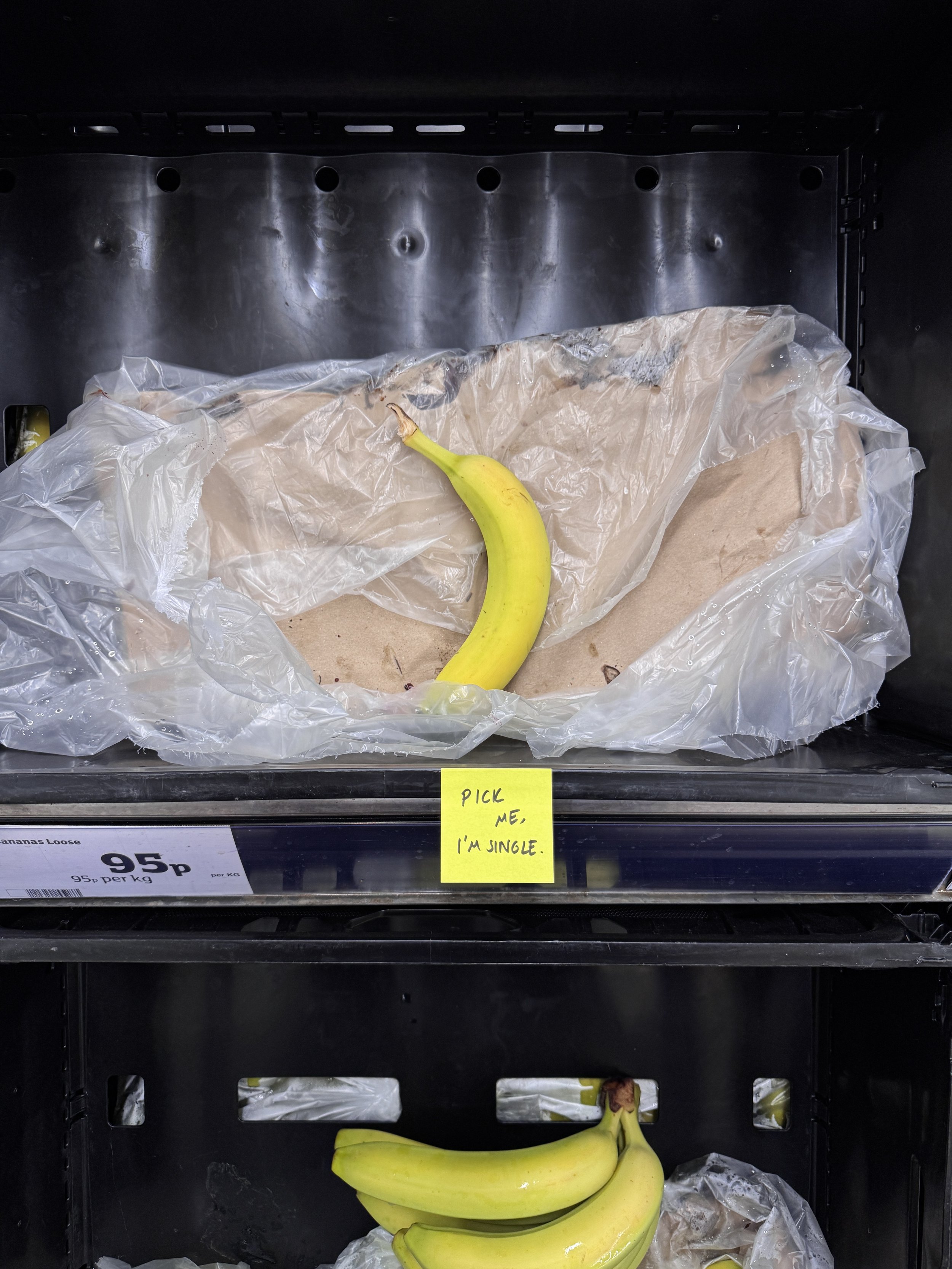
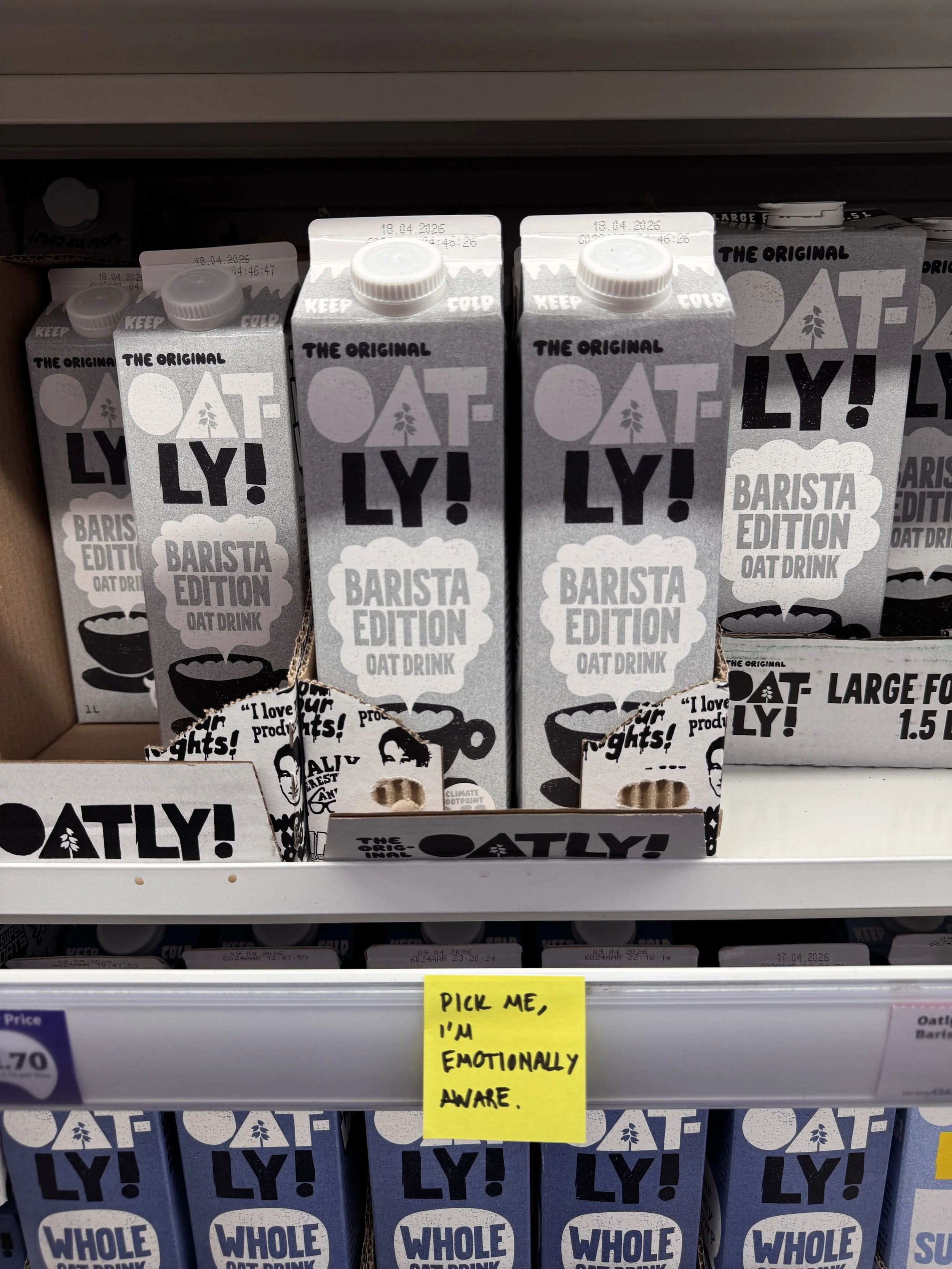
It feels inevitable, though. We’ve gained access to a dating market unique in its kind, offering so much readily attainable choice. What else is there to do? It’s all too appealing not to indulge in. We present ourselves on the shelves of desire, and fantasise about these various characters conceived solely for attraction. Pick me. Choose me. And if it doesn’t work out? Well, there will always be another one to pluck. Discard me. Are we truly more than merchandise or consumables? Eat me. Drink me. Please consume me entirely.
Yet, dates—“proper ones,” those that provide an escape from our daily routine—have never been exclusively about the time spent with a loved one. They intrinsically hold material value. There is hope for a bankrolled dinner, flowers, a nice ride... Material gain (or lack thereof) provokes an emotional response. “He said he only paid for my drink because I’d been nice,” my friend told me of one of her Hinge dates, outraged. “What does that even mean? That he’s a prize to be won or something?” Show me you can be worthy of my investment.
For someone to admit it so bluntly is uncomfortable. I think about Sally Rooney’s Normal People. The transactional nature of the relationship between the two protagonists, Connell and Marianne, has cemented itself as the most resonant depiction of my own dating experiences. I grew up dreaming of a love story like Edward and Bella’s in Twilight, everlasting devotion and all. When, at the age of 12, I was introduced to Jane Austen’s Pride and Prejudice, it wasn’t the inherent capitalistic condition of the women she wrote about that stuck with me, but the endearing “enemies to lovers” trope between Mr Darcy and Elizabeth Bennett. Partners, women especially, have always been treated as consumables throughout history. Still, I never thought I’d be negotiating myself as a good to trade.
What makes Connell and Marianne’s relationship so interesting to dissect is that it isn’t so explicitly transactional at first glance. There’s no dowry, no proper financial exchange between the two; Connell is ashamed to ask Marianne if he can live with her for a few months when he cannot afford his rent, whereas her Dublin home is fully paid for. Their differing social status (both social and monetary) occasionally hinders their bond because of the resulting mutual shame, but what they really trade in is emotional capital. Through her characters, Rooney offers a new perspective on relational transactions. “I’m not a religious person, but I do sometimes think God made you for me,” Connell tells Marianne. His declaration is touching at first read, but the implication of spiritual and emotional ownership is undeniable. Rooney subtly exposes that even when direct material exchange is divorced from the equation, our relational decision-making is still inherently dictated by the capitalist ideals in which we’re embedded. Feelings are a new type of consumable good to overindulge in to the point of fatigue.
Modern relationships have evolved beyond the binary limits of our parents and our parents’ parents. We get into ‘situationships’, have ‘sex friends’, adapt our emotional threshold for the sake of freedom—of choice, of commitment, of experiences—while still allowing ourselves to engage somewhat meaningfully with someone. “Some people react by saying that young people are putting words on ancient concepts, things older generations were already doing themselves,” sociologist Marie Bergström tells Philosophie Magazine. “On the contrary, I believe that the act of naming should be taken seriously, that it fulfils a need to designate something new, and that it thus reveals a significant social shift.” I remember my mum telling me about the boyfriends of her youth, some of whom she hadn’t even given a kiss on the cheek, but they were still “boyfriends”! I often think my stories sound outlandish to her. They’re filled with this entirely new lexicon, which often confuses her more than it clarifies what I’m trying to get across (“well, hum, no, he’s not my boyfriend, but we do kind of behave as such I guess, but it’s not the same,” I had to explain about my most recent “situationship”; she couldn’t wrap her head around what that meant exactly, and neither could I, really). We use made-up words to define these new types of relationships—surely to try and grasp what they actually represent—but what they ultimately reflect is the need not to define anything.
Is it a good or a bad thing? To each their own. “I think you can find balance and happiness in a situation that’s not picture-perfect on paper,” a friend recently told me. “So long as you’re at peace with yourself.” When does ambiguity turn into discomfort? Where do boundaries diverge? Can this institutional greed ever be satiated?
Dating apps have merely industrialised the spheres in which we operate, rendering the marketplace for emotional trading more effective; one that eases filtering, eradicates socially induced inhibitions, and most importantly, favours consumption. But to entertain this illusion of endless choice, the idea that there will always be a product better suited for our wants and needs can get lonely. I give out so much of myself, when will that be enough?
There is resilience in putting yourself “on the market” for romance. Accepting our own commodification paradoxically leads to both temporary evasion and lethargy. There is a perpetual reckoning with the parts of ourselves we lose to strangers online, ultimately blurring the lines between the persona we spend so much of our time impersonating (“Hi, I’m Leelou, I’m 5’6”, and one thing I’ll never do again is almost get kidnapped in Mexico <3”), and who we’re truly becoming behind this screen-thin front.
Once the digital walls come down, and the artifices fall through, and the novelty wears off, and our reduced attention spans can no longer bear to linger on a singular face or body, what will be left of me?
AUTHOR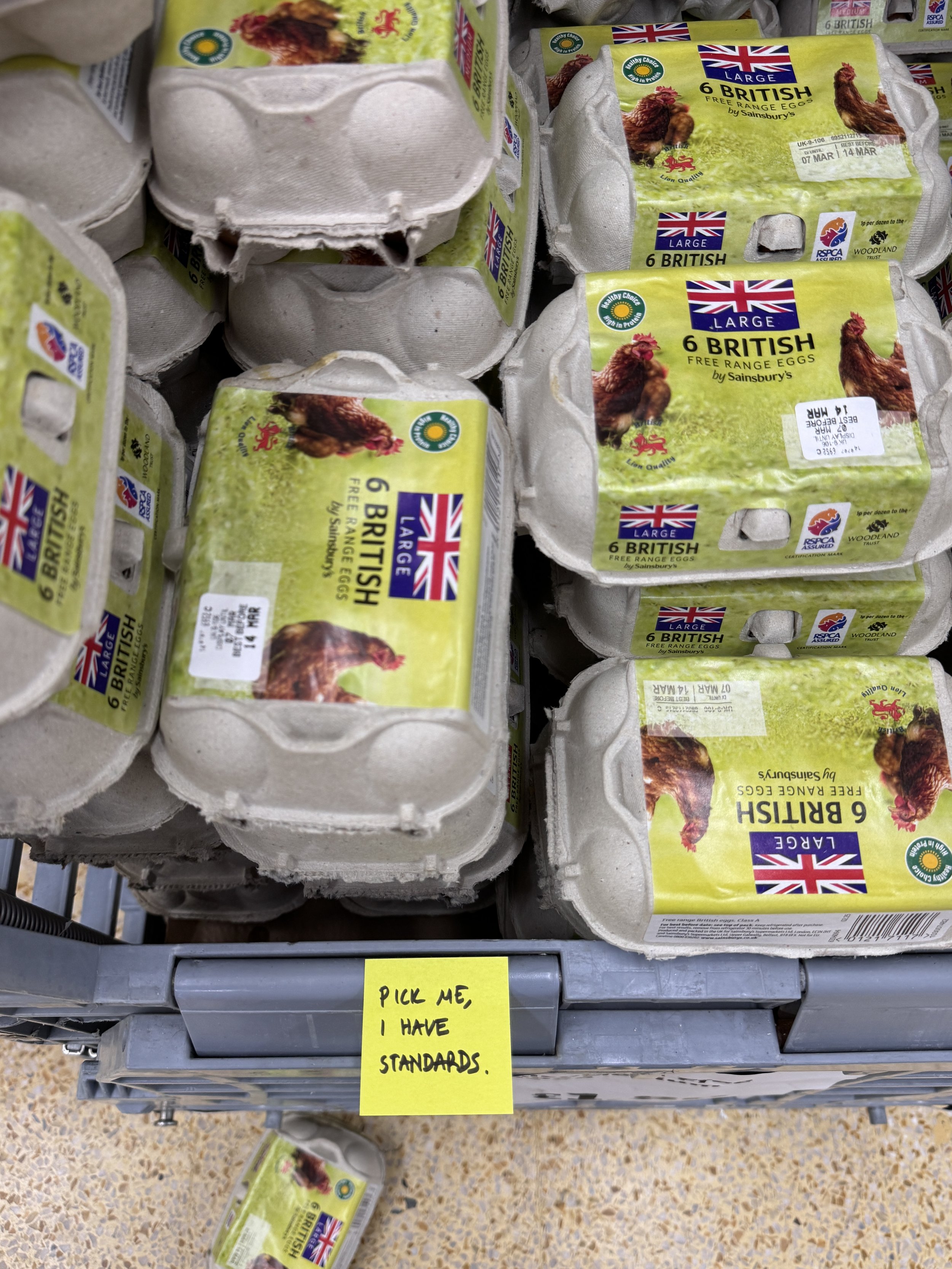
LEELOU REBOH